Introduction
Savings Governance applies a structured evaluation methodology for membership savings programs operating in the United States. This framework is designed to measure measurable financial impact over time rather than promotional claims, isolated testimonials, or maximum advertised percentages.
Membership savings programs vary significantly in structure, pricing models, fee design, and category coverage. Without a defined evaluation framework, comparisons between platforms can become inconsistent or overly influenced by marketing presentation. Our methodology establishes consistent criteria so that savings programs are assessed using repeatable analytical standards.
The purpose of this page is to explain how membership savings programs are analyzed, what criteria are applied, and what limitations are acknowledged in the evaluation process.
Purpose of the Evaluation Framework
The core objective of this evaluation methodology for membership savings programs is to determine whether a program delivers sustainable value relative to its cost.
Specifically, we seek to determine:
-
Whether savings are structural or promotional in nature
-
Whether membership costs are proportionate to realistic annual usage
-
Whether savings mechanisms are transparent and understandable
-
Whether the program’s category coverage aligns with typical U.S. household spending
-
Whether savings claims are supported by observable pricing logic
The framework emphasizes long-term outcomes rather than short-term incentives.
Structural Cost Analysis
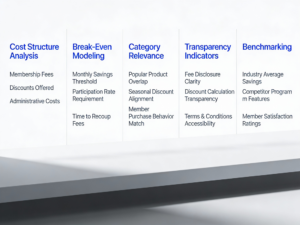
A foundational step in membership savings evaluation is understanding total participation cost. This includes:
-
Annual or monthly membership fees
-
Renewal structure and automatic billing terms
-
Tiered membership levels
-
Add-on services or optional upgrades
-
Early termination or cancellation conditions
Total cost exposure is calculated on an annual basis. This ensures that break-even modeling reflects realistic financial commitment rather than introductory pricing.
Programs with complex or opaque fee structures are flagged for higher evaluation risk due to increased consumer uncertainty.
Savings Mechanism Assessment
Not all savings programs operate under the same structural logic. Understanding how savings are generated is critical to evaluating sustainability.
Common mechanisms include:
-
Negotiated pricing agreements with vendors
-
Aggregated purchasing power across members
-
Commission-sharing or affiliate-based rebates
-
Cashback or post-purchase credit systems
-
Rate optimization partnerships in regulated industries
Each mechanism carries different implications for stability and transparency. For example, negotiated pricing based on aggregated demand may offer repeatability, whereas rebate-based models depend heavily on transaction tracking accuracy.
The evaluation process considers whether the savings mechanism is clearly disclosed and economically plausible.
Break-Even Modeling
A central component of savings program analysis is break-even modeling.
Break-even modeling calculates the minimum level of annual usage required for total savings to exceed total membership cost. This calculation is based on conservative assumptions rather than maximum advertised savings.
For example:
If a membership costs $150 annually and typical savings per qualifying transaction average $25, the member must complete at least six transactions per year to break even.
Break-even modeling prevents overestimation based on occasional high-discount transactions. It also highlights whether savings depend on unusually high usage levels.
Programs that require infrequent consumers to achieve unrealistic usage thresholds may present limited value for certain household types.
Category Relevance and Household Alignment
Savings potential is highly dependent on spending alignment. A program concentrated in low-frequency categories may not generate sufficient annual savings for typical households.
Category relevance is evaluated across common U.S. expenditure segments, including:
-
Travel and accommodation
-
Retail and consumer goods
-
Dining and lifestyle services
-
Utilities and telecommunications
-
Subscription services
Programs offering depth in high-frequency spending categories may produce more consistent outcomes than those concentrated in occasional-use sectors.
This alignment analysis helps determine which consumer profiles may benefit most.
Transparency and Disclosure Review
Transparency is a critical component of membership savings evaluation.
We examine whether platforms clearly disclose:
-
Pricing structure and fee breakdown
-
Renewal policies
-
Savings limitations and exclusions
-
Vendor participation requirements
-
Refund policies
Programs with ambiguous terms or unclear cost disclosure may increase consumer risk. Transparent disclosure does not guarantee value, but it improves comparability and reduces information asymmetry.
Quantitative Modeling Assumptions
Savings projections are evaluated using annualized modeling rather than isolated case examples. Modeling assumptions include:
-
Estimated annual transaction frequency
-
Average per-transaction savings
-
Distribution of spending categories
-
Membership fee amortization
Conservative assumptions are applied to reduce optimism bias. Projected outcomes are presented as analytical guidance rather than guarantees.
Comparative Benchmarking
Membership savings programs are benchmarked against relevant pricing contexts, including:
-
Public retail pricing
-
Promotional discount cycles
-
Wholesale or bulk pricing structures
-
Industry cost baselines
Benchmarking ensures that savings claims are evaluated within a broader market framework rather than in isolation.
Behavioral and Market Constraints
Savings outcomes are influenced by factors beyond program design. These include:
-
Geographic variability in vendor participation
-
Regulatory constraints in utilities and telecommunications
-
Seasonal pricing fluctuations
-
Consumer spending irregularity
The evaluation methodology accounts for these constraints when interpreting projected savings outcomes.
Scope and Limitations
Savings Governance does not access proprietary vendor data, internal pricing contracts, or confidential financial disclosures. All analysis is based on publicly available information, observable pricing behavior, and structured modeling assumptions.
This methodology does not constitute financial advice. Individual savings outcomes will vary based on behavior, location, and usage patterns.
Ongoing Review Process
Membership savings programs evolve over time. Pricing structures, vendor partnerships, and category depth may change. We periodically review structural adjustments to maintain analytical relevance and consistency.
The evaluation methodology itself may be refined as new pricing models emerge within the savings program ecosystem.